
A skilled Rolling Mills Consultant does more than advise from the outside. In a steel plant, the right consultant improves production flow and reduces waste. They also solve operating issues before they cause costly downtime. This matters because energy is a major cost in steel production. The World Steel says that energy may be responsible for 20-40% of production cost. Hence, better control of processes is not an optional thing.
Plant owners, operators, and project teams now rely more on rolling mill consultancy services. Rolling mills consume large amounts of energy. TERI’s field study found major efficiency gaps in many steel rolling mills. The study also showed strong potential for energy savings. Modern technologies, automation, and better operating practices can help achieve this. In other words, a strong steel rolling mill consultant helps a plant run smarter, not just harder.
Why rolling mill consulting matters now
Modern rolling mills are under constant pressure. They must produce more, waste less, and keep quality stable. At the same time, plants are expected to manage energy, maintenance, and product consistency with tighter control. Worldsteel explains that steelmakers improve performance by comparing results with standard reference levels. This helps them identify process gaps and inefficiencies. That is exactly where a rolling mill process optimization approach adds value.
Modern steel and rolling plants now use predictive control and energy management. They also use operational monitoring to reduce costs and improve availability. ABB also offers rolling mill optimization services. These services include continuous monitoring and real-time expert support. These systems optimize energy use, reduce costs, and improve operational availability. ABB also offers rolling mill optimization services. These services include continuous monitoring and real-time expert support.
What a Rolling Mills Consultant actually does
A good Rolling Mills Consultant looks at the plant as a system. The job is not only to inspect equipment. It is also to study flow, energy use, product quality, and maintenance discipline. Rolling mill consultancy services include process audits. They also help improve production, analyze equipment, and support modernization. TERI’s steel rolling mill manual highlights these areas clearly. These include furnace operation, roll pass design, lubrication, capacity optimization, and auxiliary automation.
That means a consultant may help with questions like these: Why is the mill consuming too much power? Why are roll changes interrupting output? Why is quality varying from shift to shift? Why is the cooling system not performing as expected? A skilled steel rolling mill consultant should identify the root causes behind these issues. They should also recommend practical solutions.
Common rolling mill problems and how they affect output
The most common common rolling mill problems are usually not dramatic at first. They often begin as small losses. However, those small losses stack up fast. TERI states that poor equipment selection can reduce rolling mill efficiency. Weak maintenance and outdated technologies can also create problems. The same study also highlights the importance of better lubrication and capacity optimization. It also recommends computerized roll pass design and improved process cooling.
That is why consultants pay close attention to the whole operating chain. They check furnace pressure and material temperature. They also examine capacity utilization, roll condition, compressed air systems, and cooling systems. In addition, precise alignment matters. Industry guidance shows that precision alignment improves product quality. It also reduces scrap and increases operating efficiency. So, when a plant sees quality drift or excess downtime, the issue is often not one single machine. It is usually the interaction between several parts of the line.
The 4 types of rolling mills
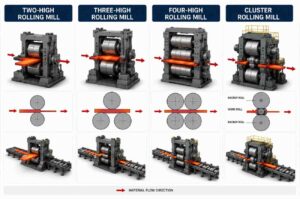
If you are asking this from a practical planning angle, the answer is simple but important. Many engineering guides describe four common rolling mill types. These include two-high, three-high, four-high, and cluster mills. Bellcliffe’s technical overview explains these rolling mill categories clearly. Ulbrich also notes that rolling mills are selected based on the product, metal type, and process requirements. Britannica also explains that modern rolling mills can use multiple roll sets. The arrangement depends on the product being manufactured.
Here is the practical takeaway.
Two-high mills are simple and widely used for repeated passes.
Three-high mills improve efficiency because the drive direction does not change between passes.
Four-high mills are useful when better flatness and lower rolling force are needed.
Cluster mills are often used when work rolls need strong backup support.
What good process optimization looks like
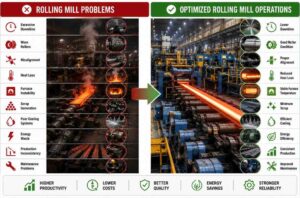
A strong rolling mill process optimization plan does not start with new equipment. It starts with a diagnosis. TERI’s report shows that better operating and maintenance practices can improve performance. Proper furnace control and auxiliary system management also play an important role. Advanced technologies can reduce energy use. Process automation can also lower the carbon footprint. Advanced technologies can reduce energy use. Process automation can also lower the carbon footprint. For instance, the consultant should know which problems to deal with first, next, and lastly.
In real plant operations, optimization can improve roll pass design and lubrication. It can also reduce crop-end waste, stabilize furnace temperature, and improve energy scheduling. Primetals also shows that energy storage can improve plant availability. Demand forecasting can also help reduce operating costs. So, process optimization is not only about output. It is also about stability, availability, and cost control.
How to Select the Right Rolling Mills Consultant
Selecting the right consultant does not rely on whose voice is louder. Rather, it is more about the person who knows the plant inside and out. A reliable Rolling Mills Consultant should understand long-product and flat-product rolling, energy efficiency, roll pass design, maintenance routines, and the relationship between furnace performance and final output. TERI’s manual shows that these areas directly affect productivity and energy consumption. A consultant who ignores them may overlook major improvement opportunities.
Good consultants will have these three qualities: experience, process knowledge, and help to implement it. A consultant should be able to articulate the reason for the problem, the cost, and how to solve it. That is especially important for buyers searching for rolling mill consultancy services. The real value comes from practical results, not theory. The value is in measurable operational improvement.
Why industrial expertise matters more than generic advice
A steel rolling mill consultant must understand the plant in context. Steel production is not a single-step operation. It is a chain of connected processes, and rolling is one of the most energy-sensitive stages in that chain. Worldsteel notes that steelmakers improve competitiveness when they improve energy efficiency. TERI also shows that technology affects rolling mill performance. Maintenance discipline and operating practices also play a major role. So, generic consulting language is not enough here. The advice must be technical, specific, and grounded in plant reality.
Many plants prefer consultants who explain modernization in simple language. They also want clear guidance on automation and process control. If the team understands what they are suggesting, they will be able to make faster decisions. This will save time and reduce scrap rate and production inconsistency.
How Swati Global Supports Rolling Mill Operations
Modern rolling mills need reliable industrial support. This helps maintain production efficiency and process stability. This is where Swati Global fits into the steel manufacturing ecosystem.
Steel plants want better performance. They also want higher energy efficiency and smoother production flow. That is why industrial expertise is important. Swati Global supports modern steel and rolling mill operations with industry-focused solutions.
Businesses now want better process optimization and reliable plant performance. Because of this, they prefer partners who understand real industrial challenges and operational needs.
Conclusion
A good rolling mill consultant does more than advise from a distance. The right consultant helps a plant reduce waste, improve output, stabilize quality, and control energy use. Rolling mill process optimization is now a priority for modern steel plants. Energy costs, downtime, and product consistency directly affect profitability. TERI’s findings and WorldSteel’s cost data both show that there is real value in improving the way rolling mills are designed, run, and maintained.
When searching for rolling mill consultancy, you should first identify the areas where your company is losing money. From there, it is important to look at solutions that